

Travel
Peace in Gaza and Israel is a Celebration of Resilience, Opportunities, and Challenges


The end of bloodshed, unification, rebuilding, and the new Opportunities that will come with it include tourism, but also the fear of increasing authoritarianism. President Trump received a nomination for the Nobel Peace Prize from Palestine.
With a note handed to US President Trump during a press conference this afternoon, it opens the door for a different world for Israel and Palestine, with the people of Gaza, the Middle East, and the rest of the world- a path to peace and the release of Israeli hostages and Palestinian prisoners.

In a rare moment, both democratic and republican leaders in the United States congratulated President Trump for his leadership in this process.

At the same time, the fear of the president using this acknowledgment at home to take advantage of this situation by justifying even more drastic ways to fight his opponents, and have the National Guard control American cities. Israel’s President Netanyahu may have to face history.
Suppose the work by Qatar, Saudi Arabia, Jordan, Egypt, the EU, the United States, and other countries is successful. In that case, it will change the world and also open up enormous new possibilities for tourism everywhere. Going coincides with Riyadh Air launching its operations at the end of this month- it becomes not only good news, but also profitable news.
In the meantime, the people of Gaza who are still alive may also be celebrating having a glimpse of hope to survive, but they urgently need help immediately. Rebuilding Gaza, getting a terrified population back on track, enabling them to overcome hate, will cost billions and a lot of goodwill, friendship, and care.
It can be assumed that Israel will have the resources and will spare no effort to welcome their beloved surviving hostages to come back home as heroes.
This is the message received from Dov Kalmann, a World Tourism Network Hero from Tel Aviv, and submitted at 6 am Israeli time this morning.
Yessssssssss we are all celebrating here. The end of bloodshed on both sides, unification, rebuilding, the return of sanity – and who knows, the first signs of peace! Shalom, salaam! History at its best!
From Palestine, Amer Al Azem sent eTN a message for US President Donald Trump saying:
Dear President Trump,
Gaza, which has seen both human and structural devastation, yet inspired the world and shaped minds and policies, welcomes you not as a colonizer or investor, but to make history. I believe it would be remarkable for history to record your visit to besieged Gaza and the human mark you could leave on a land that embodies both resilience and suffering.
We have read about the agreement on the initial phase of the Trump plan, and this is good news for everyone. The important thing is that this agreement leads to an end to the genocide in Gaza.
I nominate President Trump, Greta Thunberg, Francesca Albanese, and the Palestinian doctors for the Nobel Peace Prize. If the war does not end, I will have to withdraw President Trump’s nomination.
I also invite you to visit Gaza, because leaders are defined by their actions and achievements.
I extend to you an invitation to visit Gaza and contribute to its reconstruction as a human who feels humanity, knowing that your presence would leave a lasting impact on minds and hearts. I also invite thousands of journalists to accompany you during this visit to document a historic moment that could be immortalized in human memory.
Amer Al Azem, CEO


Travel
Sandals and Beaches Lead a Tourism Comeback for Jamaica, as Minister Bartlett Has A Christmas Wish For Visitors

Jamaica welcomes the world back with renewed spirit as Sandals spearheads the island’s tourism revival. From reopened resorts to revived attractions, momentum is building. This Christmas, Jamaica’s Tourism Minister offers a hopeful message, inviting travelers to return and play a meaningful role in the nation’s bright new chapter.
Jamaica is stepping confidently into a new era of renewal, optimism, and global re-engagement. As travelers return in steady waves and investment energy rises across the island, the nation’s tourism sector is experiencing a revival led in large part by homegrown hospitality powerhouse Sandals Resorts International (SRI).
This winter season marks a symbolic turning point. With five major Sandals and Beaches resorts now reopened—Sandals Dunn’s River, Sandals Royal Plantation, Sandals Ochi, Sandals Negril, and Beaches Negril—the island’s north coast is once again buzzing with the rhythms of visitors rediscovering Jamaica’s famous warmth, culture, and natural beauty.
Sandals Sets the Pace for Jamaica’s Tourism Resurgence

Sandals® Resorts: Made Of Caribbean [Official Website]
The Caribbean is more than a place—it’s a state of mind. We’ve got endless ways to open your senses to the Caribbean’s natural wonders.
At the center of this comeback is SRI Executive Chairman Adam Stewart, who describes the nation’s current moment as “a rising tide of confidence.” With airports fully operational and marquee attractions—from Dunn’s River Falls to Seven Mile Beach—ready for exploration, Stewart says Jamaica is primed to welcome the world back with open arms.
Earlier this month, Sandals hosted nearly 400 travel advisors and industry partners at its immersive “Back to Jamaica” showcase, offering firsthand experiences meant to reignite global enthusiasm for the destination.
“Seeing is believing,” Stewart said during the event at Sandals Dunn’s River. “Feeling the sand, hearing the music, tasting the island—this is what reminds the world why Jamaica is a place they return to again and again.”
A Christmas Wish From Jamaica’s Tourism Minister
Jamaica’s Tourism Minister extended a heartfelt message to the global community, calling on travelers and investors to be part of the nation’s forward momentum.
“The best Christmas gift Jamaica could receive is the return of our visitors—those who love our island and believe in our future,” the Minister noted. “Every traveler who steps onto Jamaican soil doesn’t just take a vacation—they support families, communities, and the continued growth of our nation.”
His holiday wish is not merely symbolic. Tourism remains one of Jamaica’s most vital economic engines, touching sectors from agriculture to transportation. As travelers come back, their presence fuels job creation, supports local businesses, and breathes life into the cultural spaces that give Jamaica its dynamic identity.
Communities Poised to Benefit From a New Chapter
The impact of tourism’s return extends beyond beaches and resorts. Across the island, artisans, tour operators, musicians, farmers, and small-business owners stand ready to reconnect with visitors.
Jamaica’s government and private sector leaders aim to channel this resurgence into sustainable, community-centered growth, ensuring that the benefits of tourism reach deeper and wider than ever before. With Sandals’ major investment and reopening push, the island has a strong anchor for this renewed chapter.
“Welcome Home” — Jamaica’s Message to the World
For an island known for its soul-stirring music, unbreakable spirit, and unmatched hospitality, the new season brings more than economic recovery—it brings emotional restoration.
As Stewart shared while celebrating the reopening of the resorts:
“Our guests don’t just visit Jamaica—they come home to it. And the moment they return, they feel the magic again.”
With the holidays approaching, Jamaica stands ready: ready to shine, ready to grow, and ready to welcome the world back to its shores.
Travel
Cinnamon Hotels & Resorts prioritises guest safety, colleague support, and community recovery as affected properties resume full operations

 Cinnamon Hotels & Resorts stands united with its communities during this period of adversity and remains committed to supporting recovery efforts while ensuring the safety and wellbeing of its guests and employees. Adverse weather linked to Cyclone Ditwah temporarily affected operations at several of its properties. The hotel group has issued a statement that says, ‘At a time when many of the communities continue to feel the impact of the floods, our thoughts are with everyone affected. Throughout this period, our priority has remained the safety and wellbeing of our teams, our communities, and the guests in our care. All guest safety protocols were upheld, in house guests remained safe, and timely updates were shared with our travel partners and stakeholders to ensure clarity and continuity. Thanks to the swift response and dedication of our teams, we are pleased to confirm that all affected resorts Cinnamon Lodge Habarana, Habarana Village by Cinnamon, Cinnamon Citadel Kandy, Kandy Myst by Cinnamon, and Trinco Blu by Cinnamon have now resumed welcoming guests.’
Hishan Singhawansa- CEO -Cinnamon Hotels & Resorts, says, “Despite the temporary disruptions caused by Cyclone Ditwah, I am immensely proud of how swiftly and safely our teams restored full operations. Our focus now is twofold, continuing to support the communities around us as they rebuild, and ensuring the comfort and wellbeing of every guest who places their trust in us. The warmth and resilience of Sri Lanka’s hospitality remain unchanged, and all our properties are fully operational and ready to warmly welcome Indian travellers this holiday season.”
As of 1st December 2025, all Cinnamon Hotels & Resorts properties are fully operational. Resorts’ operations are functioning as normal. Importantly, business continues uninterrupted across its entire portfolio, with guests arriving, staying, and departing as scheduled. All bookings, arrivals, and planned activities continue as scheduled.
As part of its commitment to supporting communities during this time, Cinnamon Hotels & Resorts together with the John Keells Group and the John Keells Foundation continues to assist those affected. As a hospitality brand, its priority is to support the nation’s recovery while ensuring the continued comfort and safety of all guests and communities. Cinnamon Hotels & Resorts will continue to provide updates as needed and stands firmly with the people of Sri Lanka.

At dawn, when the sea is still the color of blown glass, fishermen once pulled their wooden boats across the warm, flour-soft sands of Levera Beach. The ritual was as old as the village itself. But on a recent morning, the path was blocked by a new sign: PRIVATE PROPERTY — AAA Kaf Investment Co.
The Saudi-listed conglomerate, little known on the island just a few years ago, now holds a 99-year lease on 64 hectares of this protected coastline — a stretch locals consider among the most ecologically delicate in Grenada. Its logo, printed in metallic gold, is now the most visible symbol of a transformation unfolding across the Caribbean, driven not by storms or political upheaval but by a surge of foreign capital reshaping who owns the region’s land, passports, and future.
A Quiet Redefinition of Sovereignty
For decades, Caribbean states have marketed themselves through sun-drenched advertisements and cruise brochures. But increasingly, their most valuable export isn’t tourism — it’s sovereignty itself.
The region’s citizenship-by-investment (CBI) programs, introduced as revenue lifelines after economic shocks, have evolved into a billion-dollar industry. According to the Eastern Caribbean Central Bank’s 2024 report, member nations issued 4,813 passports through these programs last year — a 31 percent jump. Saudi nationals accounted for 433 of them, placing the Kingdom among the fastest-growing cohorts of new Caribbean citizens.
Collectively, the programs generated $579 million, or about 6.4 percent of the GDP of the participating Eastern Caribbean states.
“Passports have become the new offshore oil,” said one regional economist, who requested anonymity due to government ties. “Small states are effectively monetizing sovereignty — and foreign investors understand its value better than most.”
Deals That Reorder the Map
Among the region’s leaders, foreign investment — particularly from Saudi Arabia — is often framed as an engine of development. But parliamentary records, gazette notices, and corporate filings reviewed by this publication reveal a series of concessions whose scale and duration are unprecedented.
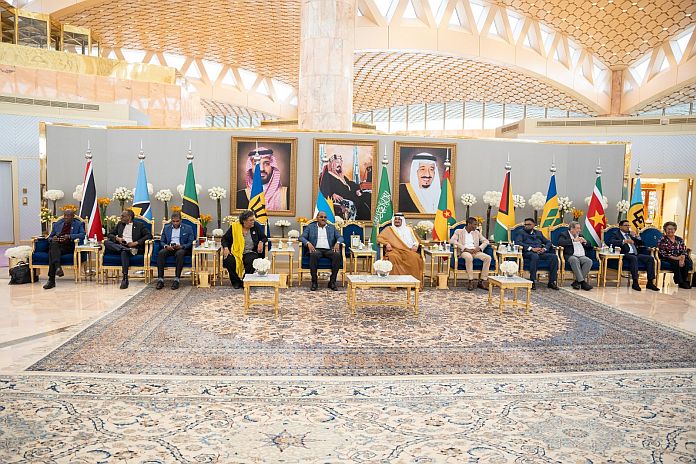
Grenada: The $2.1 Billion Beach Deal
In July 2024, Grenada’s Parliament approved a deal granting AAA Kaf Investment Co. a century-long lease on Levera Beach. The price: $1 per hectare per year for the first decade. The company’s planned resort complex is valued at $2.1 billion — more than Grenada’s annual GDP.
“An entire coastline for the price of a mango,” muttered an opposition MP during a parliamentary break, still incredulous months later.
St. Kitts & Nevis: A Tax Holiday for Turtle Beach
Dar Al-Arkan, a Riyadh-based developer, was approved for a 15-year corporate tax holiday for its $550 million marina and resort at Turtle Beach (CBI/2024/047). The project, marketed to affluent Middle Eastern buyers, includes villas eligible for citizenship.
Barbados: Petrochemicals at the Water’s Edge
In Barbados, Sabic Petrochemicals secured 25 years of exemptions — covering corporate taxes, land-transfer fees, and withholding taxes — to build a $300 million methanol terminal, according to GN 164/2024 of the Official Gazette.
Jamaica & Suriname: Energy and Ports
Agreements involving the Saudi Ports Authority and Saudi Aramco total nearly $800 million, spanning port modernization, energy infrastructure, and long-term crude supply arrangements. Individually, these deals appear to reflect economic ambition. Together, they represent a reordering of access and control across the Caribbean basin.
Soft Power, Hard Assets
Saudi Arabia’s approach aligns with Vision 2030, Crown Prince Mohammed bin Salman’s sweeping plan to diversify the Kingdom’s economy and expand global influence. Tourism, logistics, and overseas infrastructure are key pillars.
The Caribbean, with its strategic voting blocs in international bodies, offers the Kingdom something money cannot easily buy: diplomatic leverage.
“These are not just business decisions,” said a former Caribbean ambassador to the U.N. “They are geopolitical investments.”
China and the UAE are also active investors, but analysts note that Saudi deals stand out for their speed, opacity, and the extent of tax concessions.
A Transparency Gap Widens
Governance watchdogs warn the region is entering dangerous territory.
In Transparency International’s 2024 Corruption Perceptions Index, Suriname (40), China (43), Jamaica (44), Grenada (56), Saudi Arabia (59), and Barbados and the UAE (68). Below the “serious risk” threshold is lower than 50. The global average, however, is 36.
Yet, in each country, critical documents — including MOUs and concession agreements — were not tabled within the required disclosure period. Grenada’s Clerk of Parliament confirmed in November 2025 that several Saudi-related documents remain “under review.”
Without transparency, public trust erodes, and political accountability falters.
Environmental Costs, Measured in Mangroves

Beyond economics and geopolitics, the region’s ecological future may be the biggest casualty.
Resorts and marinas often require clearing mangroves — natural buffers against storm surge and erosion. Marine biologists warn that removing these ecosystems increases climate vulnerability in one of the world’s most hurricane-prone regions.
“It’s a paradox,” said Dr. Maureen Baptiste, a coastal ecologist based in Trinidad. “Caribbean leaders advocate fiercely for climate justice internationally, while approving domestic projects that undermine their own resilience.”
Winners and Losers in a Changing Caribbean
Winners:
• Developers with multi-decade tax breaks
• Foreign investors with new passports, property, and political access
• Political elites who broker deals and secure donor networks
Losers:
• Local communities priced out of beaches and housing
• Future governments constrained by long-term financial commitments
• Domestic entrepreneurs unable to compete with tax-free foreign giants
“Economic leakage” — profits flowing out of the region — is already visible in the tourism sector. Analysts worry the new deals may compound that trend.
‘People Just Want a Say’
In Sauteurs, the fishing village nearest Levera Beach, residents say they were never consulted about the century-long lease. Some fear they’ll soon need permission to reach the sea their families worked for generations.
“We’re not against development,” said a 63-year-old fisherman, sitting beside his faded blue pirogue. “But we should have a say in what happens to our land. We’re the ones who live here.”
What Comes Next
Regional leaders argue they cannot afford to turn away investment. But critics insist the choice is not between development and stagnation — it is between inclusive growth and a century of dependence.
Across the islands, quiet conversations are growing louder: What does sovereignty mean when beachfronts, ports, and even passports are for sale?
If You Care: What Ordinary People Can Do
- Talk about the issue. Many Caribbean citizens and members of the diaspora have no idea how rapidly foreign governments are acquiring land and influence.
- Support local journalists, artists, and community groups documenting these changes.
- Spend intentionally when traveling. Patronize locally owned guesthouses, tour guides, and restaurants to keep money circulating in communities.
Change is inevitable. But who gets to shape it — and who benefits — is still in contention. For now, the only constant in the Caribbean’s new era of dealmaking is the rising tide.

Sandals and Beaches Lead a Tourism Comeback for Jamaica, as Minister Bartlett Has A Christmas Wish For Visitors

How to Create a More Organized and Comfortable Living Space

Cinnamon Hotels & Resorts prioritises guest safety, colleague support, and community recovery as affected properties resume full operations

How Saudi Billions Are Quietly Reshaping the Caribbean?

Prague Convention Bureau unveils new campaign video celebrating the city’s creative MICE identity

Embraer develops new AI-powered Smart Planning solution

JetBlue launches Daytona Beach service and expands Fort Lauderdale network

OACM and WTFI Forge Strategic Partnership to Make Ocean Protection a Core Pillar of Global Tourism

ECTAA welcomes balanced compromise on revised Package Travel Directive

Go World Travel Magazine Unveils 12 Bucket List Adventures to Gift This Year

Black History Facts I had to Learn on My Own pt.6 📜

If Africa never existed ???😲😭

Black history is f**ked up! 🫢 #ChappellesShow #DaveChappelle #Comedy #BHM #BlackHistoryMonth

A Closer Look: Afro-Mexicans 🇲🇽

Navigating My First Weeks at the Met Office and Championing Climate Science

No African pre-Columbus DNA? 🤯🤯 #history #mesoamerica #mexico #african

😱Ancient African Technologies that would Surprise most people! Part 2 #africanhistory

Major African Tribes taken away during the Atlantic Slave Trade🌍 #slavetrade #africanamericanhistory

South African History Summary 🇿🇦 From First Settlements to the Anglo Boer War

Cameroon 🇨🇲 World Cup History (1962-2022) #football #realmadrid #shorts

Evidence of African Nobility all over Medieval Europe.

african presence in mexico part 1

Did Africans Discover America Before Christopher Columbus?

The Black Presence in Renaissance Europe in 4K- Historical Paintings of Africans Brought To Life

Africans Visited the Americas Long Before Columbus | African History

Dr. Ivan Van Sertima – African Presence in Early Asia

African Presence in Early Europe – Dr Ivan Sertima – PART 1

History of Cameroon

Black History (It’s Yours) | Black History Month Rap Anthem | Animated Music Video

History of Africa from the 16th to the 20th Century
-
 African History2 years ago
Black History Facts I had to Learn on My Own pt.6 📜
-
 African History1 year ago
If Africa never existed ???😲😭
-
 African History1 year ago
Black history is f**ked up! 🫢 #ChappellesShow #DaveChappelle #Comedy #BHM #BlackHistoryMonth
-
 African History6 years ago
A Closer Look: Afro-Mexicans 🇲🇽
-
 Weather1 year ago
Navigating My First Weeks at the Met Office and Championing Climate Science
-
 African History3 years ago
No African pre-Columbus DNA? 🤯🤯 #history #mesoamerica #mexico #african
-
 African History2 years ago
😱Ancient African Technologies that would Surprise most people! Part 2 #africanhistory
-
 African History3 years ago
Major African Tribes taken away during the Atlantic Slave Trade🌍 #slavetrade #africanamericanhistory